Did the Dutch Send Families to Settle Their Lands
The Dutch colonization of the Americas began with the establishment of Dutch trading posts and plantations in the Americas, which preceded the much wider known colonization activities of the Dutch in Asia. While the kickoff Dutch fort in Asia was congenital in 1600 (in present-day Indonesia), the beginning forts and settlements along the Essequibo River in Republic of guyana date from the 1590s. Bodily colonization, with the Dutch settling in the new lands, was non as mutual as with other European nations. Many of the Dutch settlements were lost or abased past the terminate of the 17th century, but holland managed to retain possession of Suriname until it gained independence in 1975. Among its several colonies in the region, only the Dutch Caribbean still remains to be office of the Kingdom of the netherlands today.
Mainland In North America [edit]

1685 reprint of a 1656 map of the Dutch Due north American colonies showing extent of Dutch claims, from Chesapeake Bay and the Susquehanna River in the South and West, to Narragansett Bay and the Providence-Blackstone Rivers in the Eastward, to the St. Lawrence River in the North
In 1602, the Democracy of the 7 United Netherlands chartered a young and eager Dutch East India Visitor (Vereenigde Oostindische Compagnie or "VOC") with the mission of exploring Northward America's Rivers and Trophy for a direct passage through to the Indies. Along the way, Dutch explorers were charged to claim any uncharted areas for the United Provinces, which led to several significant expeditions and, over fourth dimension, Dutch explorers founded the province of New Netherland. By 1610, the VOC had already commissioned English language explorer Henry Hudson who, in an attempt to observe the Northwest Passage to the Indies, discovered and claimed for the VOC parts of the present-day United States and Canada. Hudson entered the Upper New York Bay past sailboat, heading upward the Hudson River, which now bears his proper noun.
On March 27, 1614, the States General would move abroad from traditional monopolistic endeavors and accept a new and freer arroyo to exploration and commercial evolution of the New World; the issuance of the General Charter for Those who Find Any New Passages, Havens, Countries, or Places stated that "the said undertaking to be commendable, honorable, and serviceable for the prosperity of the United Provinces and wishing that the experiment exist gratuitous and open to all and every of the inhabitants of this state, have invited and do hereby invite all and every of the inhabitants of the United Netherlands to the aforesaid search."[1]
In 1614, Adriaen Block led an trek to the lower Hudson River in the Tyger, and and then explored the East River aboard the Onrust, becoming the outset known European to navigate the Hellegat in order to proceeds access to Long Isle Sound. Block Island and Block Island Sound are befittingly named in his honor. Upon his render to Amsterdam in 1614, Block compiled a map, and applied the name 'New Netherland' for the showtime time to the area betwixt English language Virginia and French Canada, where he was later on granted exclusive trading rights by the Dutch government. Cake rapidly ascended and became Manhattan's offset monopolist.

Expanse settled by the Dutch in 1660
After some early trading expeditions, the first Dutch settlement in the Americas was founded in 1615: Fort Nassau, on Castle Isle along the Hudson, near present-day Albany. The settlement served mostly as an outpost for trading in fur with the native Lenape tribespeople, but was later replaced past Fort Orange. Both forts were named in award of the House of Orange-Nassau.
Past 1621, the United Provinces had charted a new company, a trading monopoly in the Americas and West Africa: the Dutch West India Visitor (Westindische Compagnie or WIC). The WIC sought recognition as founders of the New World – which they ultimately did as founders of a new Province in 1623, New Netherland. That year, some other Fort Nassau was built on the Delaware River near Gloucester City, New Bailiwick of jersey.
In 1624, the showtime colonists, mostly Walloons and their slaves-spring servants, arrived to New Netherland by the shipload, landing at Governors Island and initially dispensed to Fort Orange, Fort Wilhelmus and Kievets Hoek. In 1626, Director of the WIC Peter Minuit purchased the isle of Manhattan from the Lenape natives and started structure of Fort Amsterdam, which grew to become the main port and capital, New Amsterdam. The colony expanded to outlying areas at Pavonia, Brooklyn, Bronx, and Long Island.
On the Connecticut River, Fort Huys de Goede Hoop was completed in 1633 at present day Hartford. Past 1636, the English language from Newtown (now Cambridge, Massachusetts) settled on the northward side of the Picayune River. In the Treaty of Hartford, the edge of New Netherland was retracted to western Connecticut and by 1653, the English language had overtaken the Dutch trading post.
Expansion forth the Delaware River beyond Fort Nassau did non begin until the 1650s, later on the takeover of a Swedish colony which had been established at Fort Christina in 1638. Settlements at Fort Nassau and the short-lived Fort Beversreede were abandoned and consolidated at Fort Casimir. By 1655 Fort Christina, sitting in what is today Wilmington, had already been renamed Fort Altena.
Not all inhabitants of New Netherlands, Manahattan'due south first European colonizers, were ethnically Dutch, but in reality came from many European countries. Along with the large number of African native peoples—originally brought over as slaves—many New Netherlanders were Walloons, Huguenots, Germans, Scandinavian and English relocated from New England.[ citation needed ]
In 1664, an English naval trek ordered by Prince James, Duke of York and of Albany (later Male monarch James II & VII) sailed in the harbor at New Amsterdam, threatening to set on. Being profoundly outnumbered, Director-Full general Peter Stuyvesant surrendered after negotiating favorable articles of capitulation. The Province and then took a new name, New York (from James's English title).[two] Fort Orange was renamed Fort Albany (from James's Scottish championship). The region between the lower Hudson and the Delaware was deeded to proprietors and called New Bailiwick of jersey.
The loss of New Netherland led to the Second Anglo–Dutch State of war during 1665–1667. This disharmonize ended with the Treaty of Breda, which stipulated that the Dutch give upwardly their merits to New Netherlands in exchange for Suriname.
From 1673 to 1674, the territories were once more briefly captured by the Dutch in the Third Anglo–Dutch State of war, just to be returned to England at the Treaty of Westminster. In 1674, Dutch navy captain Jurriaen Aernoutsz also briefly captured 2 forts in the French colony of Acadia, which he claimed equally Dutch territory the new colony of New Holland. However, Aernoutsz's appointed administrator, John Rhoades, chop-chop lost control of the territory after Aernoutsz himself left for Curaçao to seek out new settlers, and with effective command of Acadia remaining in the hands of French republic, Dutch sovereignty existed only on paper until the Netherlands surrendered their merits in the Treaties of Nijmegen.
Caribbean Sea [edit]
Netherlands (Dutch) Antilles [edit]
Dutch colonization in the Caribbean started in 1634 on St. Croix and Tobago (1628), followed in 1631 with settlements on Tortuga (now Île Tortue) and Sint Maarten. When the Dutch lost Sint Maarten (and Anguilla where they had built a fort shortly after arriving in Sint Maarten) to the Spanish, they settled Curaçao and Sint Eustatius. They regained one-half of Sint Maarten in 1648, from so on sharing the island with France. The border between the two portions of the isle continued to be modified periodically, earlier being set for good in 1816.
- Sint Maarten in 1618
- Bonaire in 1634
- Curaçao in 1634
- Sint Eustatius in 1636
- Aruba in 1637
- Saba in 1640
- Tortola, Virgin Gorda, Jost van Dyke earlier 1640
Until deep into the 19th century, the at present Venezuelan islands of Aves, the Aves archipelago, Los Roques and La Orchila were also considered by the Dutch government to exist office of the Dutch West Indies.
The Netherlands Antilles remained an overseas territory of the Netherlands. It was granted self-dominion in 1954. In 1986, Aruba was granted autonomy, separately from the other islands. On October 10, 2010, the Netherlands Antilles was dismantled. Like Aruba, the islands Curaçao and Sint Maarten became constituent countries of the Kingdom of the netherlands. Bonaire, Saba, and Sint Eustatius became special municipalities of kingdom of the netherlands.
Tobago [edit]
The Netherlands fabricated numerous attempts to colonize Tobago (Nieuw-Walcheren) in the 17th century. Each time, the settlements were destroyed by rival European powers. Dutch settlements on Tobago:[3]
- 1628 – i Jan 1637: Fort Vlissingen; massacred by the Spanish
- Sept 1654 – Jan 1666: Forts Lampsinsberg, Beveren, and Bellavista; conquered by British, destroyed by French
- 1667 – 18 December 1672: Nieuw-Vlissingen; destroyed past British
- ane Sept 1676 – vi Dec 1677: Fort Sterreschans; destroyed by French
Virgin Islands [edit]
As a group, the islands are known as the Maagdeneilanden in Dutch. The Dutch established a base on St. Croix (Sint-Kruis) in 1625, the same year that the British did. French Protestants joined the Dutch but conflict with the British colony led to its abandonment before 1650. The Dutch established a settlement on Tortola (Ter Tholen) before 1640 and afterward on Anegada, Saint Thomas (Sint-Thomas) and Virgin Gorda. The British took Tortola in 1672 and Anegada and Virgin Gorda in 1680.
Due south America [edit]
Brazil [edit]

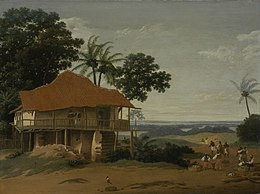
From 1630 onward, the Dutch Republic gained control of a large portion of northeastern Brazil from the Portuguese. The Dutch Westward India Company set up their headquarters in Recife; it too exported a tradition of religious tolerance to its New Earth colonies, most notable to Dutch Brazil.[4] The governor, Johan Maurits, invited artists and scientists in society to help promote migration to the new S-American colony. However, the Portuguese fought dorsum and won a significant victory at the 2nd Battle of Guararapes in 1649. On 26 January 1654, the Dutch Republic surrendered and signed a capitulation returning control of all the northeastern Brazil colony to the Portuguese. After the end of the First Anglo-Dutch State of war in May 1654, the Dutch Republic demanded that Nieuw Holland (Dutch Brazil) be returned to Dutch control. Under threat of an occupation of Lisbon and a reoccupation of northeastern Brazil, the Portuguese, already involved in a war against Spain, acceded to the Dutch need. However, the new Dutch political leader Johan de Witt deemed commerce more important than territory, and saw to information technology that New Kingdom of the netherlands was sold back to Portugal on August 6, 1661, through the Treaty of the Hague.[five]
After the devastation caused by World War II, the Dutch government stimulated emigration to Commonwealth of australia, Brazil, and Canada. Brazil was the just nation to allow the inflow of large groups of Catholics. With the consent of the Brazilian government, the Catholic Dutch Farmers and Market place-gardeners Spousal relationship (Dutch: Katholieke Nederlandse Boeren- en Tuindersbond) coordinated the emigration process. A group of approximately 5000 migrants from the province of Northward Brabant arrived in Brazil, establishing their first colony at the subcontract of Fazenda Ribeirão in the state of São Paulo. Holambra I was founded in fourteen July 1948. After a referendum in 1991 where 98 % of the population voted in favor of political autonomy for the area, Holambra gained city status in Jan 1993.
Famous for its large product of flowers and plants and for the yearly result Expoflora, Holambra receives thousands of tourists each year. In April 1998 this fact was recognized every bit Holambra gained the status of Estância Turística, touristic location. Further immigration from kingdom of the netherlands, concluded up creating the cities in Brazil where the majority of the population descends from these Dutch immigrants. These cities are Holambra, Castrolanda, Carambei, Não me Toque, Witmarsum (where most of the population are descended from Dutch Western frisian immigrants), Arapoti and Campos de Holambra.
Chile [edit]
In 1600, the Chilean city of Valdivia was conquered past the Dutch pirate Sebastian de Cordes.[6] He left the city later a few months. In 1642, the VOC and WIC sent a fleet to Chile to conquer Valdivia and its supposed gold mines. This expedition was led past Hendrik Brouwer, a Dutch admiral. In 1643, Brouwer died earlier effecting the conquest of the Chiloé Archipelago; his lieutenant Elias Herckmans succeeded in capturing the ruins of the urban center, which he refortified and named Brouwershaven.[7] [8] Finding no gold simply many hostile natives, the Dutch shortly abandoned the outpost.
The second emigration from the Netherlands to Chile was in 1895. Nether the so-called "Chilean General Inspector of Colonization and Immigration", a dozen Dutch families settled between 1895 and 1897 in Chiloé, particularly in Mechaico, Huillinco and Chacao. In the aforementioned period Hageman Egbert arrived in Republic of chile.[9] with his family, 14 Apr 1896, settling in Rio Gato, near Puerto Montt. In improver, family unit Wennekool which inaugurated the Dutch colonization of Villarrica.[ten]
In the early twentieth century, at that place arrived in Chile a large group of Dutch people from South Africa, which had been established where they worked mainly in construction of the railway. When the Boer War, which would eventually lead to the British annexation of both republics in 1902. These emigrants decided to emigrate to Republic of chile with the aid of the Chilean government.
On four May 1903, a grouping of over 200 Dutch emigrants sailed on the steamship "Oropesa" shipping company "Pacific Steam Navigation Company, from La Rochelle (La Pallice) in France. The bulk of migrants were born in holland: 35% was from North Holland and S The netherlands, thirteen% of North Brabant, ix% of Zeeland and equal number of Gelderland.
On June 5, arrived past train to their last destination, the city of Pitrufquén, located south of Temuco, near the village of Donguil. Another group of Dutchmen arrived shortly after to Talcahuano, in the "Oravi" and the "Orissa". The Netherlands colony in Donguil was christened "New Transvaal Colony. There were established more than than 500 families in social club to outset a new life. Between vii February 1907 and Feb 18, 1909 above the concluding group of families Boers.
It is currently estimated at about 50,000 descendants of Dutch, mostly located in Malleco, Gorbea, Pitrufquén, Faja Maisan and around Temuco and Osorno.[11] [12]
Guianas [edit]
The Dutch Westward Indian Visitor built a fort in 1616 on the Essequibo River. The Dutch traded with the Indian peoples and, equally in Suriname, established saccharide plantations worked past African slaves. While the coast remained nether Dutch control, the English established plantations due west of the Suriname River. Conflict between the two countries meant parts of the region inverse hands a number of times, but past 1796 United kingdom of great britain and northern ireland had control of the region. The Netherlands ceded the colonies of Essequibo, Demerara, and Berbice to United kingdom of great britain and northern ireland in 1814.
The colony in Suriname had originally been founded in the 1650s past Lord Francis Willoughby, the British governor of Barbados. Information technology was captured past the Dutch nether Abraham Crijnsen during the 2d Anglo–Dutch War. On July 31, 1667, under the Treaty of Breda the Dutch offered New Netherland (including New Amsterdam, modernistic-twenty-four hour period New York City) in exchange for their saccharide factories on the coast of Suriname. In 1683 Suriname was sold to the Dutch West Bharat Company. The colony adult an agricultural economic system based on African slavery. England controlled Suriname during the Napoleonic Wars from 1799 until 1816, when it was returned to the Dutch. The netherlands abolished slavery in 1863 and later imported indentured labor from the British Raj and the Dutch Due east Indies to keep the economic system going. Internal cocky governance was granted in 1954 and full independence in 1975. The prospect of independence prompted many to migrate to the Netherlands. Political instability and economic turn down afterwards independence resulted in fifty-fifty more than migration to kingdom of the netherlands. The Surinamese community in kingdom of the netherlands is now about as large as half of the population in the state itself (about 350,000).
See too [edit]
- Atlantic World
- Dutch Empire
- Dutch Westward Republic of india Company
- New York history
- New Amsterdam
- New Netherland
- Netherlands Antilles
- New World Dutch barn
References [edit]
- ^ Full general Lease for Those who Discover Any New Passages, Havens, Countries, or Places; March 27, 1614
- ^ Goodfriend, Joyce (2009). Present at the Creation: Making the Case for the Dutch Founders of America (seven ed.). p. 259-269.
- ^ Ramerini, Marco. Colonial Voyage. "Dutch and Courlanders on Tobago: A History of the Kickoff Settlements, 1628–1677 Archived 2012-eleven-ten at the Wayback Machine". Accessed 23 November 2012.
- ^ Israel, Jonathan I.; Schwartz, Stuart B. (2007). The Expansion of Tolerance: Organized religion in Dutch Brazil (1624-1654). Amsterdam: Amsterdam University Press. ISBN978-9053569023.
- ^ Facsimiles of 20 manuscripts from the Dutch Westward India Company, relating the events in Brazil in the 17th century, from the outset capture of Salvador, expansion, defeat and final peace treaty (PT & NL).
- ^ "Tradiciones Coloniales" (in Spanish).
- ^ "Historia Valdivia" (in Spanish). Archived from the original on 2009-05-31. Retrieved 2010-09-08 .
- ^ "Intento de Colonización" (in Spanish).
- ^ Egbert Hageman.
- ^ Netherlands in Republic of chile.
- ^ Dutch immigration. Archived August 18, 2013, at the Wayback Machine
- ^ Holando-bóers al sur de Chile.
Further reading [edit]
- Antunes, Catia; Gommans, Jos, eds. (2015). Exploring the Dutch Empire: Agents, Networks and Institutions, 1600-2000. New York: Bloomsbury Academic. ISBN978-1474236423.
- Boxer, Charles R. (1989). The Dutch Seaborne Empire: 1600-1800 . Penguin Books. ISBN978-0140216004.
- Van Groesen, Michiel (2017). Amsterdam'due south Atlantic: Print Culture and the Making of Dutch Brazil. Philadelphia: University of Pennsylvania Press. ISBN978-0812248661.
- Innes, J. H. (2015). New Amsterdam and its People; Studies, Social and Topographical, of the Town Under Dutch and Early on English Rule. London: Andesite Press. ISBN978-1296752668.
- State of israel, Johnathan (1989). Dutch Primacy in Earth Merchandise, 1585-1740. New York: Oxford University Press. ISBN978-0198227298.
- Jacobs, Jaap (2009). The Colony of New Netherland: A Dutch Settlement in Seventeenth-Century America. Ithaca, NY: Cornell University Printing. ISBN978-0801475160.
- Klooster, Wim (2016). The Dutch Moment: War, Trade, and Settlement in the Seventeenth-Century Atlantic World. Ithaca, NY: Cornell University Press. ISBN978-0801450457.
- Nimako, Kwame; Willemsen, Glenn (2011). The Dutch Atlantic: Slavery, Abolitionism and Emancipation. London: Pluto Press. ISBN978-0745331089.
- Shorto, Russell (2005). The Island at the Middle of the World: The Epic Story of Dutch Manhattan and the Forgotten Colony That Shaped America. New York: Vintage Books. ISBN978-1400078677.
External links [edit]
- Dutch West Indies 1630-1975 documentary
- (in English and Dutch) "Conditions as Created by their Lords Burgomasters of Amsterdam" from 1656, about Dutch goals to populate their New World colonies
Source: https://en.wikipedia.org/wiki/Dutch_colonization_of_the_Americas
0 Response to "Did the Dutch Send Families to Settle Their Lands"
Enregistrer un commentaire